Ruqelvyn
Trail Collection
Trail Collection
Couldn't load pickup availability
- Problem Statement
Many learners reach a stage where basic Ruby terms are familiar, but the full shape of a Ruby example still takes careful study. A method may receive an array, check each item, store a result, and return a final value, while several names appear in the same block. This can make the reading path feel crowded, especially when loops, conditions, hashes, and helper-style methods appear together. Learners may also wonder how to separate one idea from another: where data begins, where a check happens, where a repeated action runs, and where the final result is formed. Trail Collection was created for learners who need wider practice with connected Ruby examples while still keeping the study format calm and organized.
- Solution
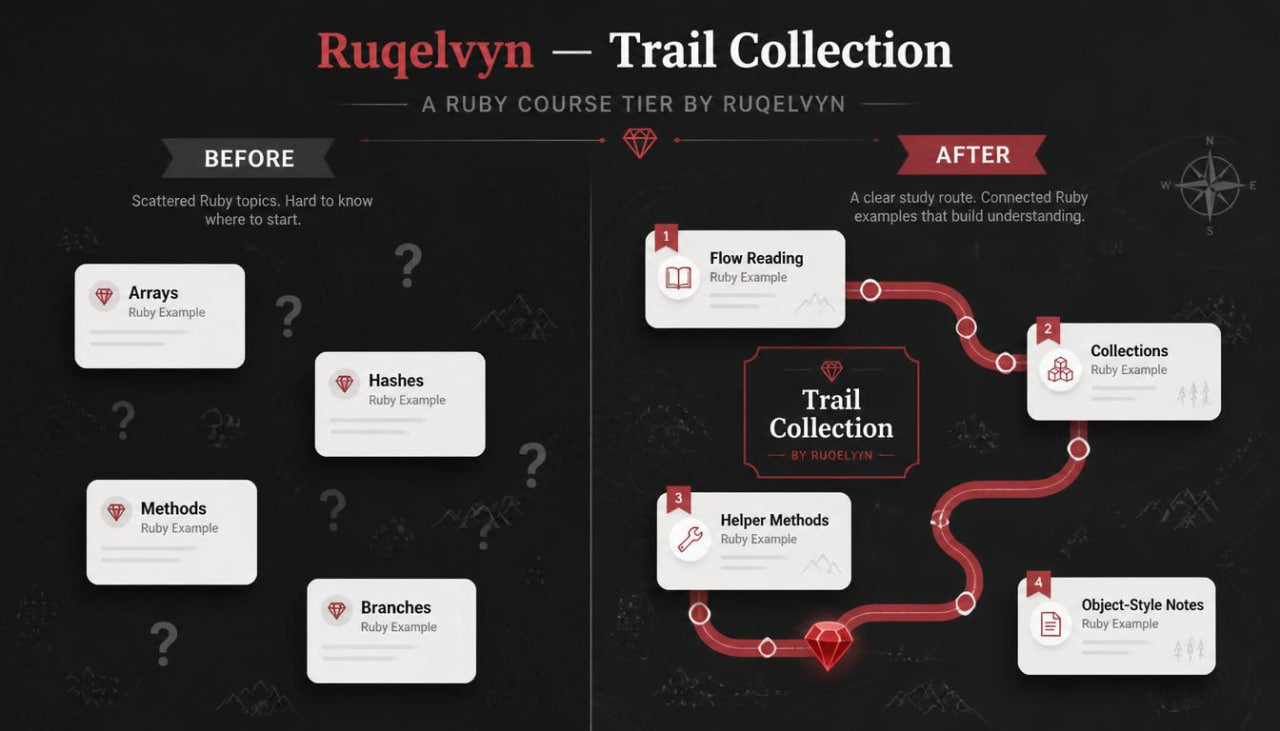
Trail Collection presents Ruby as a set of study trails, where each topic leads into the next through clear written notes and compact examples. The course moves from method reading into collection handling, then into small reusable patterns and introductory object-style thinking. Each section shows how to trace values, follow names, read branches, and describe the outcome of a block in plain language. The materials include detailed notes, recap pages, glossary entries, and practice prompts that invite steady review. This tier gives learners a broader Ruby study route without pushing them into large or crowded examples too early.
- What’s Inside
Trail Collection begins with a course orientation that explains the study route. The opening pages introduce the “trail” format: each section begins with a concept, continues with a Ruby example, then closes with a short review task. Learners are encouraged to read the material in order, but the sections are also arranged so a learner can return to one topic for review later.
The first main section focuses on tracing Ruby flow. Learners study how information moves from a starting value into a variable, from a variable into a method, and from a method into a returned result. The course uses small examples to show how Ruby lines connect. Each example includes a line-by-line reading note, helping learners identify what happens first, what changes in the middle, and what the final value represents.
The next section reviews methods in a broader way. Learners examine methods with one parameter, methods with several parameters, and methods that receive collections. The course explains how to read the method name, how to identify input names, and how to describe the returned result. Several examples compare short method bodies with longer method bodies, helping learners see how a method can remain readable when the names are chosen carefully.
Trail Collection then moves into arrays and repeated actions. This part shows how Ruby can move through a list of values and perform a small task for each item. Learners review examples that count items, collect matching values, create a new list, or prepare a readable text result. Each example includes a breakdown of the array, the item name, the repeated block, and the result. Practice prompts ask learners to describe what happens during one pass through the repeated action.
A separate section focuses on hashes and paired information. Learners study how Ruby can store labeled values and how those labels help describe information. The course includes examples with simple profile-style records, category counts, and small lookup structures. Learners compare arrays and hashes again, but this time with wider examples that show how both can appear in the same block. The notes explain how to identify keys, values, and the purpose of each pair.
The course then introduces collection reading patterns. These patterns include selecting items, counting matches, changing values into a new form, and checking whether a group contains a certain kind of item. The material does not overload the learner with heavy terminology. Instead, each pattern is named in plain language and shown through a compact Ruby example. Learners are guided to ask: What group is being reviewed? What condition is being used? What result is being formed?
Another section covers conditions inside larger Ruby blocks. Learners study examples where a branch appears inside a method, inside a repeated action, or after a value has been prepared. This section gives special attention to reading order. The notes explain which line starts the check, which branch runs in each case, and how the branch affects the result. Practice tasks ask learners to rewrite a condition in plain words before reading the answer note.
Trail Collection also includes an introduction to object-style organization. This section gives a calm first look at how Ruby can group related data and behavior under a named structure. Learners study small examples with attributes, initialization-style notes, and simple methods connected to a named object idea. The focus is not advanced design. The focus is reading: what information belongs together, what name describes the group, and what small action can be placed near that information.
A section on small helper methods follows. Learners see how a longer example can be divided into shorter named pieces. The course explains why a helper-style method can make reading simpler when each part has a clear role. Examples show one method preparing data, another checking a condition, and another returning a final text value. The notes guide learners through the relationship between the methods without turning the example into a large project.
Trail Collection includes practice pages throughout the course. These pages invite learners to trace method input, read arrays, identify hash pairs, follow a condition, describe a helper method, and explain a compact object-style example. Some tasks ask for written explanations. Others ask learners to complete a missing line, choose a clearer name, or mark where a value changes.
A set of recap pages appears near the end. These pages are arranged by topic: flow tracing, methods, arrays, hashes, conditions, helper methods, and object-style reading. Each recap gives short reminders, sample questions, and small Ruby lines for review. The recap pages are designed to help learners return to the material after finishing the course.
The glossary section expands the Ruqelvyn vocabulary with terms such as flow, helper method, data group, object-style structure, attribute, initialized value, selected item, grouped result, lookup value, and branch result. Each definition is written in plain language for repeated review.
The final section contains the Trail Review Worksheet. This worksheet brings together several short Ruby examples that include methods, arrays, hashes, conditions, and object-style structure. Learners are asked to name the parts, trace the value movement, and describe the final result. The worksheet gives the course a practical closing activity that matches the wider study route.
- Who Is This For?
Trail Collection is for learners who already understand the early Ruby topics and want a wider course built around connected examples. It is suitable for people who have studied variables, methods, arrays, hashes, loops, and conditions, and now want to see those ideas arranged in broader study blocks. It may also fit returning learners who want written materials for reviewing Ruby flow and organization.
This course is useful for learners who like structured modules, calm explanations, practical prompts, and review pages. It is not built around large application work or advanced architecture. Instead, it focuses on reading Ruby with care, tracing values through connected examples, and understanding how small pieces can be grouped into a cleaner study structure.
- What You’ll Learn
- How to trace Ruby value movement from one line to another.
- How to read methods with one or several parameters.
- How to follow arrays through repeated actions.
- How to identify keys and values inside hashes.
- How to compare ordered lists with labeled data.
- How to read conditions inside methods and repeated blocks.
- How to describe selected, counted, and reshaped values.
- How helper-style methods can divide a Ruby example into named parts.
- How to read a simple object-style structure.
- How to identify grouped data and related actions.
- How to use recap pages for later review.
- How to complete practice tasks based on connected Ruby examples.
- 30-Day Refund Note
Trail Collection includes a 30-day refund option for paid orders, based on Ruqelvyn store rules and order conditions. Customers may contact Ruqelvyn within 30 days of purchase for order-related refund questions.
Self-paced learning overview
- 📄 Digital file available after purchase
- 🕒 Long-term availability
- 🔐 Secure checkout
- 🗓️ Content updated in 2026
What format are Ruqelvyn courses provided in?
What format are Ruqelvyn courses provided in?
Ruqelvyn courses are provided as digital learning materials built around written modules, Ruby examples, practice prompts, recap notes, and organized study sections. They are made for self-paced reading and review.
Do I need previous Ruby knowledge?
Do I need previous Ruby knowledge?
No previous Ruby background is required for the starting tiers. The early materials begin with simple Ruby ideas, basic syntax, values, variables, methods, and small practice tasks.
Can I study the materials gradually?
Can I study the materials gradually?
Yes. Each Ruqelvyn tier is arranged in sections, so you can study one part at a time, return to earlier notes, and repeat practice tasks when needed.
Share