Ruqelvyn
Slate Module
Slate Module
Couldn't load pickup availability
- Problem Statement
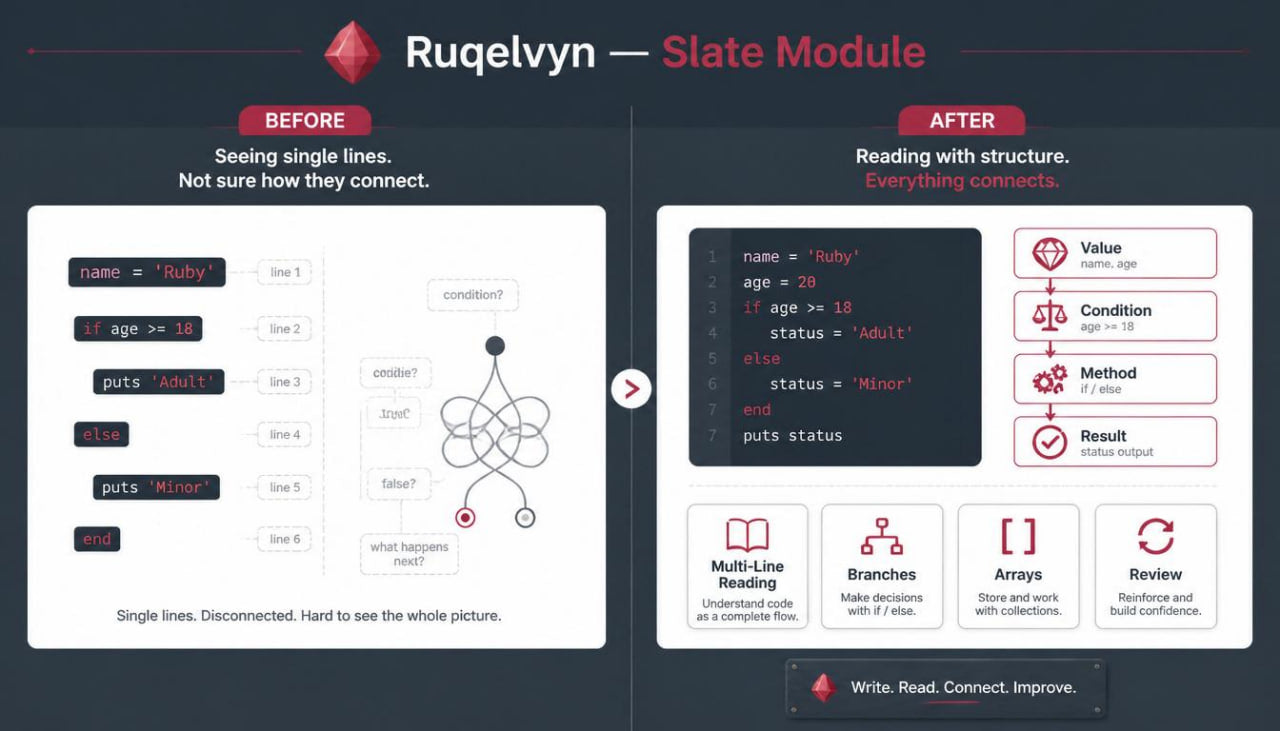
Many Ruby learners reach a point where single examples feel understandable, but a small group of connected lines can still feel hard to follow. A variable may be clear by itself, and a condition may make sense on its own, yet the learner may still pause when those parts appear together inside a method or short block. This often happens because early study materials explain topics separately but do not give enough calm practice in reading how they work side by side. Another common issue is that learners may copy a pattern without knowing why each line is placed where it is. Slate Module was created for learners who need a more structured bridge between beginner Ruby concepts and short practical code examples.
- Solution
Slate Module gives learners a wider Ruby study section built around connected examples, plain explanations, and focused review prompts. The course starts with familiar concepts, then arranges them into short Ruby blocks so learners can practice reading order, naming, conditions, and method flow. Each section breaks down the code into small parts, helping the learner describe what each line does before moving forward. The material includes recap notes, glossary terms, and practice pages for steady review. Instead of presenting large tasks too early, Slate Module keeps the examples compact while showing how Ruby ideas begin to form useful structures.
- What’s Inside
Slate Module begins with a study orientation that explains how to use the course materials. This opening section suggests a reading pattern: inspect the title of the topic, read the explanation, study the example line by line, then answer the practice prompt in your own words. The goal is to make Ruby review feel more organized and less scattered.
The first main section revisits Ruby values and variables, but with more attention to how they behave inside short blocks. Learners review text values, number values, true-or-false values, and empty-style values. The course explains how these values can be stored, compared, passed into methods, and returned from small examples. This part helps learners see that values are not only isolated pieces; they often move through several lines of code.
The next section focuses on naming patterns. Learners look at variable names, method names, and parameter names in short Ruby examples. The material explains how a name can describe a purpose, a stored value, or an action. Several examples compare unclear names with clearer alternatives, helping learners notice how naming affects review. This section also includes practice prompts where learners rewrite names to make the example easier to follow.
Slate Module then introduces a deeper look at conditions. The course shows how Ruby uses true-or-false checks to choose between different lines. Learners review simple if statements, else branches, and small comparison examples. Each example includes a plain-language explanation of the condition, the branch, and the result. The course also includes short “read before answer” tasks where learners predict which branch would run based on a given value.
Another section focuses on methods with parameters. Learners see how a method can receive information, use it inside a small block, and return a result. The course explains the difference between a method name, parameter names, inner variables, and returned values. Examples remain small but become more connected than in earlier tiers. Learners practice reading method definitions, calling methods with sample values, and describing the result in normal language.
Slate Module includes a section on return values and output-style reading. This part helps learners distinguish between a line that produces a value and a line that displays or presents information. The material explains why this difference matters when reviewing a Ruby example. Learners compare small snippets where a method returns a value, stores a value, or places a value into another expression. The aim is to make the movement of information easier to trace.
A separate section introduces arrays at a light beginner level. Learners meet arrays as ordered groups of values. The course shows how an array can hold several text items or number items, how a single item can be referenced, and how short examples can use a list-like structure. This section does not go deep into collection methods. It gives learners a first structured look at grouped values and how they appear in Ruby examples.
The next part introduces repeated actions through simple loops. Learners review short examples where Ruby moves through a small group of values and applies the same action to each item. The course explains the loop in plain terms: where the group begins, what name is used for the current item, and what happens inside the repeated block. This section is written for careful reading, not heavy memorization.
Slate Module also includes several practice pages. These tasks ask learners to identify values, rename variables, complete a short condition, explain a method, or describe what happens inside a small loop. Some prompts are written as fill-in tasks, while others ask for a short written explanation. The tasks are designed to help learners review the material without jumping into large exercises too soon.
A recap section appears near the end of the course. It gathers the main ideas from values, variables, naming, conditions, methods, arrays, loops, and return values. Each recap point is written in a direct style so learners can use it as a review page after finishing the course. The recap also includes a short checklist for reading Ruby blocks: find the values, identify the names, follow the condition, trace the method, and describe the result.
The course also includes a glossary page. This glossary expands the earlier terms and adds words such as array, item, branch, parameter, return value, loop, block, and comparison. Each term is defined in short, readable language. The glossary is meant to support review while moving into larger Ruqelvyn tiers.
The final section contains a small Ruby reading worksheet. Learners are given several short code-style examples and asked to describe what each one does. The worksheet is structured around observation rather than pressure. It helps learners practice a repeatable way of studying Ruby: read, name the parts, trace the order, and write a short explanation.
- Who Is This For?
Slate Module is for learners who already understand the first Ruby terms but want more practice reading connected examples. It is suitable for people who have reviewed values, variables, and simple methods, and now want to study conditions, arrays, loops, and return values with more structure. It may also fit learners who have seen Ruby before but want a calmer written review of beginner-to-lower-intermediate topics.
This course is useful for learners who prefer organized materials, short examples, and practical prompts. It is not designed around advanced Ruby patterns or large projects. Instead, it gives learners a careful study layer where common Ruby parts begin to work together inside compact examples. For many readers, this tier can serve as a bridge between basic Ruby notes and wider coding structures.
- What You’ll Learn
- How Ruby values move through variables, methods, and short blocks.
- How to choose clearer names for variables, methods, and parameters.
- How if and else branches are shaped in small Ruby examples.
- How to read a condition and describe which branch is used.
- How methods receive values through parameters.
- How return values can be traced from one line to another.
- How arrays hold ordered groups of values.
- How to read a simple repeated action over a group.
- How to separate stored values from displayed information.
- How to review a Ruby block line by line.
- How to use glossary notes for repeated study.
- How to complete small Ruby practice prompts with clear explanations.
- 30-Day Refund Note
Slate Module includes a 30-day refund option for paid orders, based on Ruqelvyn store rules and order conditions. Customers may contact Ruqelvyn within 30 days of purchase for order-related refund questions.
Self-paced learning overview
- 📄 Digital file available after purchase
- 🕒 Long-term availability
- 🔐 Secure checkout
- 🗓️ Content updated in 2026
What format are Ruqelvyn courses provided in?
What format are Ruqelvyn courses provided in?
Ruqelvyn courses are provided as digital learning materials built around written modules, Ruby examples, practice prompts, recap notes, and organized study sections. They are made for self-paced reading and review.
Do I need previous Ruby knowledge?
Do I need previous Ruby knowledge?
No previous Ruby background is required for the starting tiers. The early materials begin with simple Ruby ideas, basic syntax, values, variables, methods, and small practice tasks.
Can I study the materials gradually?
Can I study the materials gradually?
Yes. Each Ruqelvyn tier is arranged in sections, so you can study one part at a time, return to earlier notes, and repeat practice tasks when needed.
Share