Ruqelvyn
Loom Pathway
Loom Pathway
Couldn't load pickup availability
- Problem Statement
As Ruby study becomes broader, learners often need more than separate explanations of syntax. They may understand variables, arrays, hashes, methods, branches, loops, and object-style groups, but still need practice reading how these parts work together across several related sections. A Ruby example can begin with grouped data, pass that data through helper-style methods, check several conditions, prepare a result, and return a final value. Without a steady reading method, the learner may lose track of where each value begins, which name carries it, and why a certain branch is used. Loom Pathway was created for this stage, where the learner needs a larger, carefully arranged course that weaves Ruby topics into connected study materials without making the page feel crowded.
- Solution
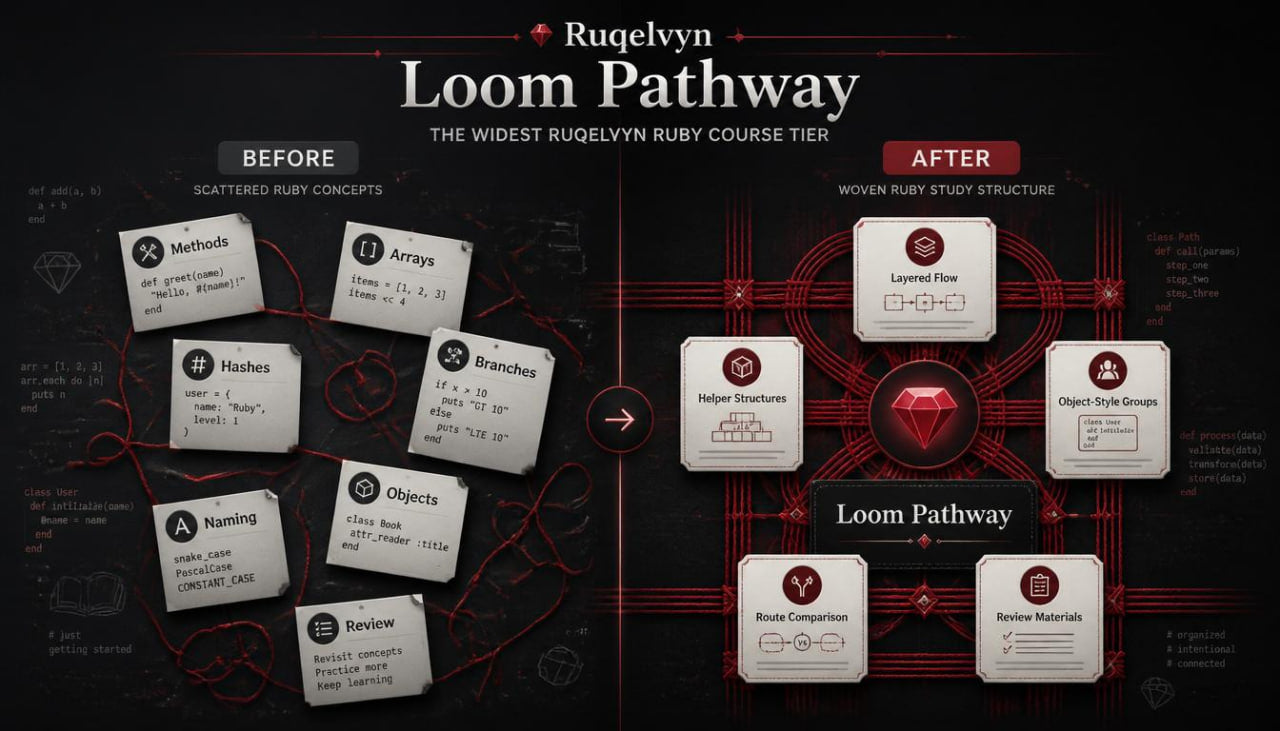
Loom Pathway gives learners a broad Ruby study route built around connected examples and repeated review habits. The course uses the idea of a loom as a structure: separate Ruby ideas become easier to study when they are woven together with clear naming, readable methods, grouped data, and practical review prompts. Each module introduces a topic, connects it to earlier material, and shows how it appears inside wider Ruby examples. Learners are guided to trace values, read method roles, follow branches, compare collections, review object-style groups, and describe returned results in plain language. The course keeps the focus on organized learning, steady reading, and practical Ruby review.
- What’s Inside
Loom Pathway begins with a course orientation that explains how to move through the material. The opening pages introduce a study rhythm based on observation, tracing, and review. Learners are encouraged to identify the starting data, follow each named part, mark where a condition appears, and describe the final value before moving into the next example. This rhythm appears throughout the course so each module feels connected to the previous one.
The first main module focuses on Ruby flow across layered examples. Learners review how information can begin as a value, become part of a collection, enter a method, pass through a branch, and return as a result. The examples are compact enough for careful reading, but wide enough to show how several Ruby ideas can work together. Each example includes line-by-line notes that explain what each part does and how it connects to the rest of the block.
The next module studies method structure in greater detail. Learners review method names, parameters, local names, helper-style methods, returned values, and method calls. The course explains how several methods can form one readable structure when each one has a clear role. Examples show methods that prepare data, check values, select items, count matches, and return simple results. Practice prompts ask learners to identify the role of each method and describe how the methods connect.
Loom Pathway then moves into collection handling. This section studies arrays and hashes in wider Ruby examples. Learners review ordered groups, labeled records, current item names, key-value pairs, selected groups, counted results, and combined collection structures. The course explains how to read a collection from the outside in: first identify the group, then identify the item or key, then follow the repeated action or lookup pattern. Review tasks ask learners to compare array-based and hash-based examples.
A separate module focuses on branch reading. Learners study if and else branches, comparison checks, empty-style checks, and branch-based returned values. The course shows how a branch can appear inside a method, inside a repeated action, or inside an object-style structure. Each branch is described in plain wording before the Ruby-style example is reviewed. This helps learners understand the purpose of the check before looking at the full block.
The course also includes a module on helper-style structure. Learners see how a larger Ruby example can be divided into smaller named parts. One helper-style method may prepare a list, another may check each item, and another may format a result. The notes explain how to follow the relationship between these parts and how to avoid losing the main path. This module is especially useful for learners who want to read wider Ruby examples with more order.
Another section expands object-style organization. Learners review how related values and related actions can be placed under one named structure. The course includes examples with initialized values, attribute-style reading, and small methods connected to the same grouped idea. The focus stays on reading and explanation. Learners study how information belongs together, how names describe the group, and how methods can work with that grouped information.
Loom Pathway includes a section on state and value movement. This part explains how a value can change role during a Ruby example. A value may begin as input, become a local name, be checked by a branch, be placed into a collection, and then become part of a returned result. Learners are shown how to mark these changes in review notes. Practice prompts ask learners to describe the state of a value at different points in an example.
A naming module follows. Learners study names for methods, parameters, arrays, hashes, current items, result values, helper-style methods, and object-style groups. The course explains how names can make the role of each part easier to review. Several examples compare vague names with clearer alternatives. Learners are asked to rename short examples while keeping the same structure and meaning.
The course also includes a module on comparing several Ruby routes. Learners study examples that begin with similar data but lead to different results. One route may select matching items, another may count them, and another may return a text summary. The course explains how to compare the structure of each route by looking at the input, method roles, collection handling, branch checks, and returned result. This helps learners read Ruby examples as organized paths rather than isolated lines.
Practice pages are included throughout Loom Pathway. These tasks ask learners to trace values, identify method roles, read collections, explain branch behavior, compare routes, rename examples, and describe object-style structures. Some tasks ask for written explanations. Others include missing-line prompts, matching prompts, or small review tables. The tasks are designed for study and review, not pressure.
Near the end, Loom Pathway includes a full recap section. The recap is arranged by topic: Ruby flow, methods, helper-style structures, arrays, hashes, branches, object-style organization, naming, state tracking, and route comparison. Each recap page includes short reminders, sample lines, and review questions. These pages help learners return to specific topics after finishing the course.
The glossary section gathers Ruby terms from the full Ruqelvyn path. It includes terms such as method role, helper-style structure, branch path, grouped record, current item, returned result, value state, object-style group, selected group, counted result, and route comparison. Each term is explained with short wording for repeated review.
The final section contains the Loom Review Sheet. This worksheet brings together multi-part Ruby examples with collections, methods, branches, helper-style structures, and object-style groups. Learners are asked to trace the starting data, identify each named role, follow the branches, compare the route, and describe the returned result. This final worksheet gives the course a practical closing activity that connects the full study path.
- Who Is This For?
Loom Pathway is for learners who have studied earlier Ruby topics and want a larger course built around connected structure. It is suitable for people who already recognize values, variables, methods, arrays, hashes, loops, branches, helper-style methods, and introductory object-style organization. It may also fit returning learners who want a written Ruby review course with broad topic coverage and steady practice prompts.
This course is useful for learners who prefer structured written modules, detailed examples, recap pages, glossary notes, and practical tasks. It is not built around large software builds or advanced engineering theory. Instead, it focuses on Ruby reading, value tracing, organized methods, grouped information, branch review, naming, object-style structure, and route comparison. Learners who want a broad written course for careful Ruby study may find this tier a fitting place in the Ruqelvyn collection.
- What You’ll Learn
- How to follow Ruby values across layered examples.
- How methods can connect through clear roles.
- How helper-style structures can divide a wider Ruby example.
- How arrays and hashes carry grouped information.
- How branches shape returned values.
- How object-style groups connect related data and actions.
- How to track value state from start to final result.
- How names affect the readability of wider Ruby examples.
- How to compare several Ruby routes that begin with similar data.
- How to read collection handling in plain language.
- How to use recap pages for repeated review.
- How to complete practice tasks based on connected Ruby structure.
- 30-Day Refund Note
Loom Pathway includes a 30-day refund option for paid orders, based on Ruqelvyn store rules and order conditions. Customers may contact Ruqelvyn within 30 days of purchase for order-related refund questions.
Self-paced learning overview
- 📄 Digital file available after purchase
- 🕒 Long-term availability
- 🔐 Secure checkout
- 🗓️ Content updated in 2026
What format are Ruqelvyn courses provided in?
What format are Ruqelvyn courses provided in?
Ruqelvyn courses are provided as digital learning materials built around written modules, Ruby examples, practice prompts, recap notes, and organized study sections. They are made for self-paced reading and review.
Do I need previous Ruby knowledge?
Do I need previous Ruby knowledge?
No previous Ruby background is required for the starting tiers. The early materials begin with simple Ruby ideas, basic syntax, values, variables, methods, and small practice tasks.
Can I study the materials gradually?
Can I study the materials gradually?
Yes. Each Ruqelvyn tier is arranged in sections, so you can study one part at a time, return to earlier notes, and repeat practice tasks when needed.
Share