Ruqelvyn
Arc Pathway
Arc Pathway
Couldn't load pickup availability
- Problem Statement
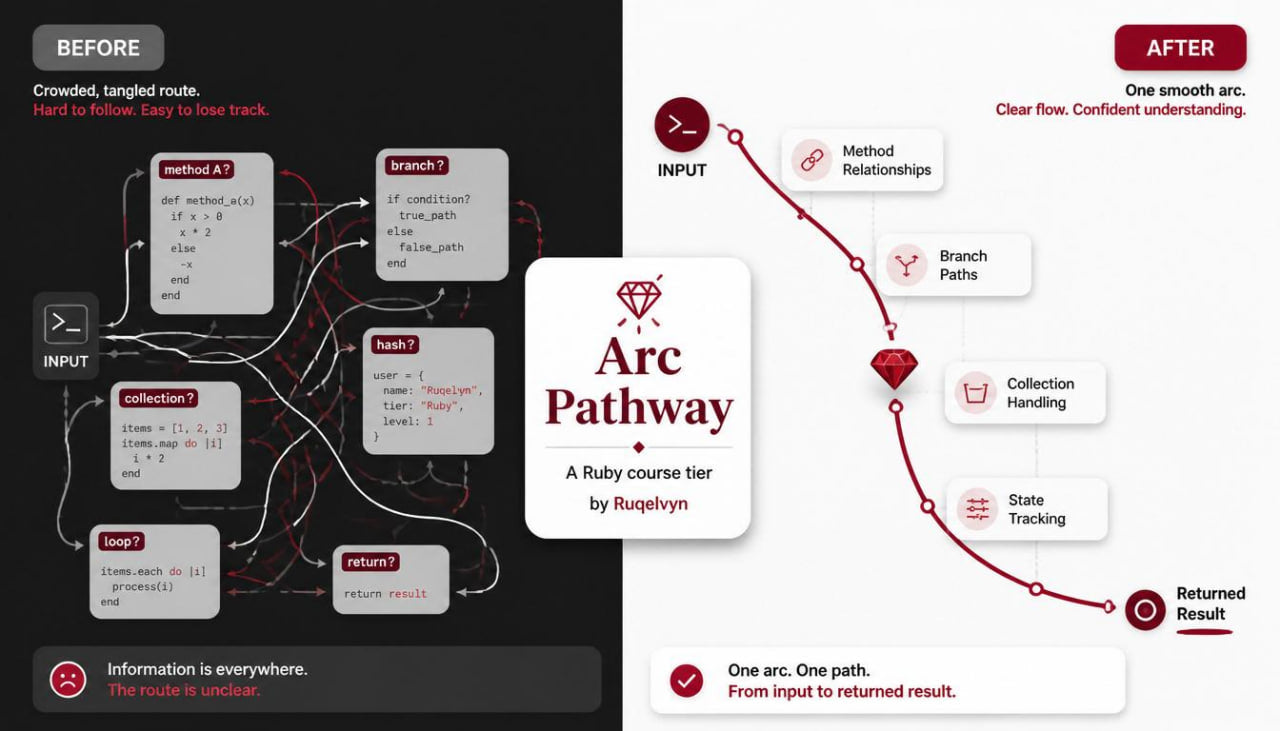
As Ruby study becomes wider, learners often meet examples where several ideas appear at once. A value may enter a method, move through a condition, pass into another helper-style method, and then become part of a returned result. Collections may also appear in several forms, such as arrays for ordered groups and hashes for labeled details. This can make the reading process feel crowded when the learner does not have a stable way to follow each part. Arc Pathway was created for learners who need more guided practice with multi-part Ruby examples, especially when methods, collections, branches, and object-style groups appear together.
- Solution
Arc Pathway gives learners a structured route for studying Ruby examples that bend from one part into another. The course uses the idea of an “arc” as a reading shape: information begins in one place, travels through a few named parts, and reaches a final result. Each module explains one part of that route, then connects it with earlier topics through compact examples and practical review prompts. Learners are guided to trace input values, identify method roles, follow collection handling, read branches, and describe final returned values in plain language. The material keeps the study experience organized by using written explanations, recap notes, glossary entries, and practice pages throughout the course.
- What’s Inside
Arc Pathway begins with an orientation section that explains the course reading method. The opening pages introduce the arc-style review process: find the starting information, identify the first named structure, follow the movement through helper-style methods, check each branch, and describe the ending value. This process is used throughout the course so learners can approach broader Ruby examples with a repeatable study habit.
The first main module focuses on Ruby movement across several lines. Learners review how values are assigned, passed into methods, used inside conditions, and returned from method bodies. The course presents compact examples where the movement of information is visible from beginning to end. Each example includes short explanation notes that name the role of each line. Learners are encouraged to describe what changes after every step rather than only looking at the final result.
The next module explores method relationships. Instead of studying each method alone, learners see how several methods can work together in one small Ruby example. One method may prepare a value, another may check a condition, and another may build a returned result. The material explains how to read these relationships without losing track of the main idea. Practice prompts ask learners to match method names with their roles and explain how one method supports another.
Arc Pathway then expands collection handling. Learners study arrays and hashes inside wider examples, with attention to how grouped information moves through methods. The array section reviews ordered groups, item names, repeated actions, selected values, and counted results. The hash section reviews labeled details, key-value pairs, simple lookup patterns, and grouped records. The course also includes examples where arrays and hashes appear together, helping learners compare ordered information with labeled information.
A dedicated module focuses on branches and decision paths. Learners review how Ruby conditions can change what value is returned or which line is used inside a block. The examples include comparison checks, empty-style checks, value presence checks, and branch-based text results. Each example is explained in plain language before the learner reviews the code-style structure. This helps learners understand the meaning of the branch before studying the symbols and indentation.
Another section covers helper-style method design for reading. The course does not push learners into large construction tasks. Instead, it shows how a Ruby example can be divided into smaller named pieces for clearer review. Learners see examples where one helper-style method checks data, another prepares a label, and another returns a final result. The notes explain how the names and method order create a visible path through the example.
Arc Pathway also introduces object-style organization in a wider way. Learners review how related values and related actions can be placed under one named structure. The course includes simple examples with initialized values, readable attributes, and short methods that work with the grouped details. The focus remains on reading and understanding the structure. Learners are not asked to handle advanced design ideas; they are guided to notice what information belongs together and how Ruby can arrange it.
The course includes a module on state tracking. This part helps learners follow how a value changes role during an example. A text value may be stored, adjusted, checked, and returned. A number may be counted, compared, and used in a final result. An array may begin as a full group and later become a selected group. The notes explain how to track these changes so the learner can understand the path instead of guessing.
A separate module focuses on naming across multi-part examples. Learners study names for methods, parameters, arrays, hashes, current items, temporary values, final results, and object-style structures. The course explains how each name should show the role of the value at that point in the example. Several comparisons show how vague names can make review harder, while clearer names can make the movement easier to follow. Practice prompts invite learners to rename small examples while preserving the same Ruby structure.
Arc Pathway also includes a section on comparing alternative routes. Learners study two Ruby examples that begin with similar information but reach different kinds of results. One may return a selected group, while another returns a count. One may use a helper-style method, while another keeps the check inside a single block. These comparisons help learners understand how Ruby structure can change depending on the purpose of the example.
The course includes practice pages after each major module. These tasks ask learners to trace values, identify method roles, explain a branch, follow a repeated action, compare array and hash use, read an object-style example, and describe the final returned value. Some tasks use short written answers. Others ask learners to complete a missing line, choose a clearer name, or match a Ruby example with its plain-language description.
Near the end, Arc Pathway includes recap pages arranged around the main study themes. There are recap notes for value movement, method relationships, collection handling, branch paths, helper-style method reading, object-style organization, state tracking, and naming. Each recap page includes short reminders and small review questions. These pages are useful for returning to specific course topics after the first reading.
The glossary section expands the Ruqelvyn vocabulary with terms such as value movement, method relationship, branch path, grouped record, state tracking, object-style structure, helper-style role, selected group, counted result, and final return. Each term is explained in plain wording for repeated review.
The final section contains the Arc Review Worksheet. This worksheet brings together several compact Ruby examples that include methods, arrays, hashes, branches, helper-style methods, and object-style groups. Learners are asked to follow the path from starting information to final result, name each part, identify the branch, and explain how the returned value is formed. This closing worksheet gives learners a practical way to review the wider course structure.
- Who Is This For?
Arc Pathway is for learners who have already studied the earlier Ruqelvyn tiers and want a wider course built around connected Ruby examples. It is suitable for people who understand variables, methods, arrays, hashes, loops, conditions, helper-style methods, and introductory object-style structure, but want more practice reading how those parts work together. It may also fit returning learners who want a written review of Ruby flow across several related parts.
This course is useful for learners who prefer structured written modules, compact examples, detailed notes, and practical prompts. It is not built around large application work or advanced architecture. Instead, it focuses on reading paths, method relationships, collection handling, branch logic, naming, state tracking, and object-style organization. Learners who want to study Ruby examples with more connected movement may find this tier useful within the Ruqelvyn course path.
- What You’ll Learn
- How to follow Ruby values across several related lines.
- How method relationships shape a wider Ruby example.
- How helper-style methods can separate a Ruby idea into named roles.
- How arrays and hashes move through multi-part examples.
- How branches change the path of a returned value.
- How to compare ordered groups with labeled records.
- How to read introductory object-style structures.
- How to track value state from beginning to final result.
- How naming affects the clarity of multi-part Ruby examples.
- How to compare two Ruby routes with different returned results.
- How to use recap pages for later review.
- How to complete practice tasks based on Ruby path reading.
- 30-Day Refund Note
Arc Pathway includes a 30-day refund option for paid orders, based on Ruqelvyn store rules and order conditions. Customers may contact Ruqelvyn within 30 days of purchase for order-related refund questions.
Self-paced learning overview
- 📄 Digital file available after purchase
- 🕒 Long-term availability
- 🔐 Secure checkout
- 🗓️ Content updated in 2026
What format are Ruqelvyn courses provided in?
What format are Ruqelvyn courses provided in?
Ruqelvyn courses are provided as digital learning materials built around written modules, Ruby examples, practice prompts, recap notes, and organized study sections. They are made for self-paced reading and review.
Do I need previous Ruby knowledge?
Do I need previous Ruby knowledge?
No previous Ruby background is required for the starting tiers. The early materials begin with simple Ruby ideas, basic syntax, values, variables, methods, and small practice tasks.
Can I study the materials gradually?
Can I study the materials gradually?
Yes. Each Ruqelvyn tier is arranged in sections, so you can study one part at a time, return to earlier notes, and repeat practice tasks when needed.
Share